This online MSW program prepares students to strengthen individuals, families and communities while addressing oppressive systems and structural inequities. Students can earn an MSW degree online at a full-time or part-time pace, choose a direct or macro practice concentration and build professional skills through classroom and agency-based learning. Across the program, students develop the judgment, cultural responsiveness and professional readiness associated with a Howard social work education.

Howard MSW Online at a Glance

Program TrackCredit HoursFastest Full-Time CompletionAgency-Based Education
Traditional
60
16 months
900+ hours
Advanced Standing
30
8 months
450+ hours

Top 15–ranked social work school1

No GRE scores required to apply

Howard’s Legacy and Black Perspective

Howard University School of Social Work has educated social work practitioners since 1935. The School launched Howard MSW Online in January 2022, extending its reach to students beyond Washington, D.C. This history informs a contemporary program focused on social justice, human dignity and service. Faculty, students and alumni carry that legacy into research, policy, advocacy, public leadership and direct service.

The curriculum is grounded in the Black Perspective, a framework that considers how oppression, self-determination and culture shape social work with individuals and communities. Students examine social justice, criminal justice reform, health care disparities and other issues in their sociocultural and historical contexts. The approach affirms the strengths of Black communities and other populations affected by oppression and discrimination.

Why Choose an HBCU MSW Program

Students seeking HBCU MSW programs can choose Howard for an academic community where Black voices, cultural knowledge and lived experiences shape professional preparation.

  • Black Perspective framework: Howard faculty connect scholarship, practice and the Black Perspective across coursework, classroom discussion and agency-based education.
  • #12 Nationally ranked program: Recognized as the #12 social work school nationally and #1 in Washington, D.C. by U.S. News & World Report,2 validating Howard’s leadership in social justice education.
  • Affirming, flexible learning: Connects live faculty and peer interaction with asynchronous coursework, academic advising, and dedicated placement support that values student wellbeing.

Request details about Howard MSW Online, to learn how our program prepares students for purposeful social work practice, including program tracks, curriculum, admissions and the online learning experience.

Get Howard MSW Info

Accredited by the Council on Social Work Education

Howard MSW Online is accredited by the Council on Social Work Education’s Commission on Accreditation (CSWE). CSWE states that accreditation extends to approved program locations and delivery methods when the degree is granted by the accredited social work program.

Accreditation is an important consideration for students planning to pursue professional licensure. Licensure requirements vary by state, so students should review the requirements of the jurisdiction where they intend to practice.

Online MSW Admissions

Howard MSW Online seeks applicants who demonstrate academic preparation and a commitment to social justice and social work. The Traditional and Advanced Standing tracks are available at full-time and part-time paces. Howard recommends the part-time pace for students who plan to work while enrolled because the full-time pace requires full-time commitment.

Application Requirements

All applicants must submit:

  • An online application.
  • A $100 application fee.
  • Three letters of recommendation.
  • College transcripts.
  • An application essay.
  • A résumé.
  • TOEFL or IELTS scores, if applicable to an international applicant.

GRE scores are not required to apply.

Traditional MSW applicants must hold a bachelor’s degree from a regionally accredited college or university, with a minimum of 60 credits in the liberal arts.

Advanced Standing applicants must hold a Bachelor of Social Work (BSW) from a CSWE-accredited institution, awarded within four years of the term start date; have earned a B or better in all social work foundation courses; and hold a 3.0 cumulative undergraduate GPA. Review the full application requirements before applying.

For the 2026–2027 academic year, tuition is $1,288 per credit. There is also a mandatory graduate fee of $846 per year. Check tuition and financial aid details for current program costs and funding information.

Connect with an enrollment specialist to discuss admissions information, application materials and upcoming deadlines for the track that fits your academic background.

MSW Admissions Info

Program Tracks and Timeline

Students seeking one-year MSW programs online can choose Howard’s Advanced Standing track if they hold a recent BSW from a CSWE-accredited institution. Eligible students can finish in 12 months full-time. Applicants with another bachelor’s degree can complete the Traditional track in as few as 16 months full-time.

Traditional MSW

  • Complete 60 credits.
  • Finish full-time in as few as 16 months or part-time in as few as 36 months.
  • Complete at least 900 agency-based education hours across four agency-based courses.

1-Year MSW Program Online (Advanced Standing Track)

  • Complete 30 credits.
  • Finish full-time in as few as 8 months or part-time in as few as 24 months.
  • Complete at least 450 agency-based education hours across two agency-based courses.

Curriculum

The Howard MSW Online curriculum integrates generalist and specialized study. Coursework addresses social work and the Black Perspective, research methods and data analysis, advocacy for marginalized communities, human behavior and social welfare policy. Students also select a concentration and a field of practice while completing agency-based education that connects classroom learning with professional settings. Guided by faculty scholarship and practice leadership, students connect theory, research, policy and advocacy to the challenges facing communities today.

Two students talk to each other in a library

Direct Practice Concentration

Develop assessment, intervention and evaluation skills for work with individuals, families and groups. Coursework includes topics such as:

  • Direct Practice Assessment
  • Intervention Planning & Strategies
  • Psychopathology
A group of students sit around a table, having a discussion

Community, Administration and Policy (CAP) Practice Concentration

Prepare for macro practice focused on communities, organizations, policy and structural change. Coursework includes topics such as:

  • Human Service Administration
  • Advanced Community Organizing
  • Advanced Social Policy Analysis

Direct vs. Macro Practice

Practice MethodPrimary FocusCore Activities
Direct Practice
Individuals, families and small groups
Assessment, intervention, prevention and connection to resources
Macro Practice
Communities, organizations, systems and policies
Program development and evaluation, policy analysis, legislative advocacy, administration and community organizing

Howard’s curriculum demonstrates the breadth of online MSW programs by preparing students for either direct or macro practice. Choose the concentration that aligns with the people, communities or systems you intend to serve. Both pathways reflect Howard’s commitment to preparing social workers who can respond to immediate needs while challenging the systems that shape them.

Agency-Based Practice Education

Agency-based education gives students an opportunity to apply course concepts in a professional setting in or near their community. Traditional students complete at least 900 hours. Advanced Standing students complete at least 450 hours.

Our placement services guide you through a step-by-step matching process: searching opportunities aligned with your goals, interviewing with local agency leadership, and securing formal approval from Howard faculty.

Placement Expectations

Weekly Commitment
About 17 placement hours per week
Travel Distance
Up to 60 miles from your preferred placement address
Placement Schedule
Standard business hours. Evening and weekend placements are limited and not guaranteed.
Employer Placement
Option to complete placement with a current employer if specific criteria are met and faculty approve

A Career Built on Real Demand

Grounded in academic rigor, the Black Perspective and agency-based learning, Howard’s MSW program prepares students for direct service, public leadership, policy, advocacy and systems change. As Howard-prepared social workers, graduates carry that foundation into their work across the profession and in the communities they serve.

The U.S. Bureau of Labor Statistics projects social worker employment to grow faster than the average for all occupations from 2025 to 2035.3

Social Work Career Outlook at a Glance

Projected Employment Growth, 2025–2035

6%4

Average Annual Openings

About 74,0005

Median Annual Wage

$61,7806

Experience Howard Online

Howard MSW Online combines weekly live video sessions with asynchronous lectures and interactive course content. Live sessions give students space to discuss social work topics with faculty and peers, while asynchronous work supports preparation between classes. Together, these formats extend Howard’s rigorous, affirming learning community beyond Washington, D.C., while maintaining meaningful faculty and peer connection.

Howard delivers the support students seek from MSW online programs throughout the student experience. Students have access to an enrollment specialist during the application process, a student success advisor during the program and a placement specialist for agency-based education. Learn more about the Howard online student experience.

Participate in live class discussion, breakout rooms and chat.

Connect with technology, academic and placement support.

Organize coursework, grades, schedules and placement hours through the online platform.

Howard Faculty: Leaders in Social Work

Howard faculty are scholars, practitioners and thought leaders who build on the legacy of Inabel Burns Lindsay, the School’s founding dean. Their teaching connects research, policy, advocacy and practice while affirming students’ lived experiences and challenging them to develop the knowledge, judgment and stamina required for ethical social work.

A group of students are cheering at graduation

ON RESILIENCE

“Sometimes, resilience is championed, [but we see it as] an additional burden of how much more people have had to go through. We want our students to be healthy, not resilient.”

– Tracy R. Whitaker, DSW, ACSW

A male lecturer is on stage, talking into a mic

ON LEADERSHIP

“Leadership is about being prepared to take the hit and keep on standing on [your] principles and fighting for social justice. [Leaders] persevere, despite everything that [is] thrown at [them].”

– Sandra Edmonds Crewe, PhD

An old, black and white photo of a woman

ON LEGACY

“Being [here] is especially fulfilling because we stand on the shoulders of giants such as founding dean Inabel Burns Lindsay. She modeled for us the relentless pursuit of solutions for our clients.”

– Altaf Husain, PhD, MSW

See Howard-Prepared Social Workers in Action

Howard University School of Social Work students and alumni apply the Black Perspective through advocacy, public service and community-centered work. Their stories demonstrate how Howard preparation can drive innovation, influence policy and advance systemic change in and beyond the communities they serve.

Jamerson W. headshot

Jamerson W.: Connecting Social Work and Ministry

After more than 20 years working on issues including violence and housing justice, Howard dual-degree graduate Jamerson W. is using social work and divinity to bridge religious, advocacy and social services communities. His work centers equity, racial justice and support for marginalized Black communities. Read more about Jamerson’s social work and ministry journey.

Zibora G. headshot

Zibora G.: Advancing Disability Justice

Howard MSW student Zibora G., executive director of Empowered Hands, advocates for disability justice and accessibility for Deaf and Hard-of-Hearing people, particularly people of color. Drawing on more than a decade in disability services, she aims to strengthen policies that advance equity and inclusion. Learn more about Zibora’s disability justice advocacy.

Cover of Brandi P

Brandi P.: Supporting Children and Families

Howard MSW alumna Brandi P., LCSWA, combines clinical social work with children’s literature to support the emotional well-being of children and families. Her book Feelings Are A Part of You helps young readers name, express and cope with emotions in age-appropriate ways. Explore Brandi’s alumni spotlight.

Rachel P.: Leading in Public Service

Howard MSW alumna Rachel P., MSW, MBA, brings more than 20 years of nonprofit and public-sector experience to her role as director of the D.C. Department of Human Services. Her career spans child welfare, housing access, homelessness prevention, youth services and agency leadership. Read about Rachel’s public-service leadership.

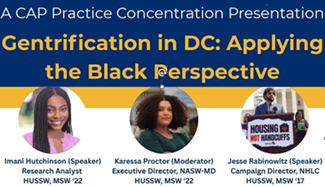
Imani Hutchinson, Karessa Proctor and Jesse Rabinowitz headshots below the title: A CAP Practice Concentration Presentation, Gentrification in DC: Applying the Black Perspective

Howard social work alumni Imani H., Jesse R. and Karessa P. examine gentrification in Washington, D.C., through the School’s Black Perspective. Their discussion connects housing policy, displacement and cultural erasure with the need for legal advocacy, policy reform and community-centered action. Explore the full story about the Black Perspective and housing justice.

Request information about Howard MSW Online to compare tracks, review admissions and tuition and understand how agency-based education fits your goals. When you are ready to move forward, begin your application.

Request Information

FAQs About Howard’s Online MSW

  • Yes. The online Master of Social Work program at Howard University is fully accredited by the Council on Social Work Education Commission on Accreditation (CSWE). Grounded in academic excellence and the Black Perspective, the School of Social Work is also highly recognized, ranking #12 in Social Work nationally, and holding the highest ranking among colleges and universities in Washington, DC, Maryland, and Virginia by U.S. News & World Report.7

  • Program length depends on your track and enrollment pace. Traditional Track students can finish in as few as 16 months full-time or 36 months part-time. Advanced Standing students can complete the 30-credit track in as few as 8 months full-time or 16 months part-time.

  • Yes. Howard offers a 30-credit Advanced Standing track for applicants who hold a Bachelor of Social Work (BSW) from a CSWE-accredited institution. Students can finish in as few as 8 months full-time or 16 months part-time.

  • Classes in the Howard MSW Online program follow a flexible hybrid format that combines weekly live, synchronous video sessions with asynchronous coursework and in-person placement requirements. Students engage in interactive virtual discussions with faculty and peers, supported by a rigorous online MSW curriculum that integrates agency-based field placements directly within their local communities.

  • While the online degree offers schedule flexibility, balancing full-time employment with the online Master of Social Work at Howard can be challenging due to field education demands. Required agency-based placements typically involve 14 to 20 hours per week during standard weekday business hours, requiring careful planning and time management.

  • For students in the online social work degree program, Howard’s agency-based education team actively assists in identifying and securing approved field placements near your local community. Depending on your track, you will complete between 450 clock hours (for Advanced Standing) and 900 clock hours (for the Traditional Track) in professional agency settings during standard business hours.

  • For the 2026–2027 academic year, base tuition is set at $1,288 per credit hour, with estimated base tuition of $57,960 for the 30-credit Advanced Standing track and $77,280 for the 60-credit Traditional Track. Applicants also pay a $100 application fee. To review complete degree costs, credit breakdowns, and fee details, visit the Howard online MSW tuition structure.

  • Yes, students enrolled in the online MSW program at Howard may qualify for federal financial aid, university fellowships, assistantships, and limited merit-based scholarships. Funding opportunities are evaluated based on academic achievement and demonstrated financial need to help support graduate social work education.

  • Admissions decisions for the online social work master’s program are rendered on a rolling basis following submitted application deadlines. Once admitted, your financial aid package (which may include loans and scholarships) will be evaluated after you complete the FAFSA and receive your official acceptance letter; you can review full details regarding the online MSW admissions process.

  • The value of Howard’s online MSW reaches beyond earning the degree. Students examine contemporary social challenges through the Black Perspective, learn alongside faculty who help move the profession forward and become part of an alumni tradition rooted in advocacy and community impact. Intensive coursework and applied practice develop the perspective and professional judgment that define Howard-prepared social workers.

Howard University partners with 2U to support the delivery of this online program. Howard University has full control over the program, including all core academic functions. Click here to learn more about 2U’s roles and responsibilities.

  1. Best Social Work Programs. (2024). U.S. News & World Report. Retrieved July 21, 2026. ↩︎
  2. Best Social Work Programs. (2024). U.S. News & World Report. Retrieved July 21, 2026. ↩︎
  3. Social Workers. (2025). U.S. Bureau of Labor Statistics. Retrieved July 29, 2026. ↩︎
  4. Social Workers. (2025). U.S. Bureau of Labor Statistics. Retrieved July 29, 2026. ↩︎
  5. Social Workers. (2025). U.S. Bureau of Labor Statistics. Retrieved July 29, 2026. ↩︎
  6. Social Workers. (2025). U.S. Bureau of Labor Statistics. Retrieved July 29, 2026. ↩︎
  7. Best Social Work Programs. (2024). U.S. News & World Report. Retrieved July 21, 2026. ↩︎